
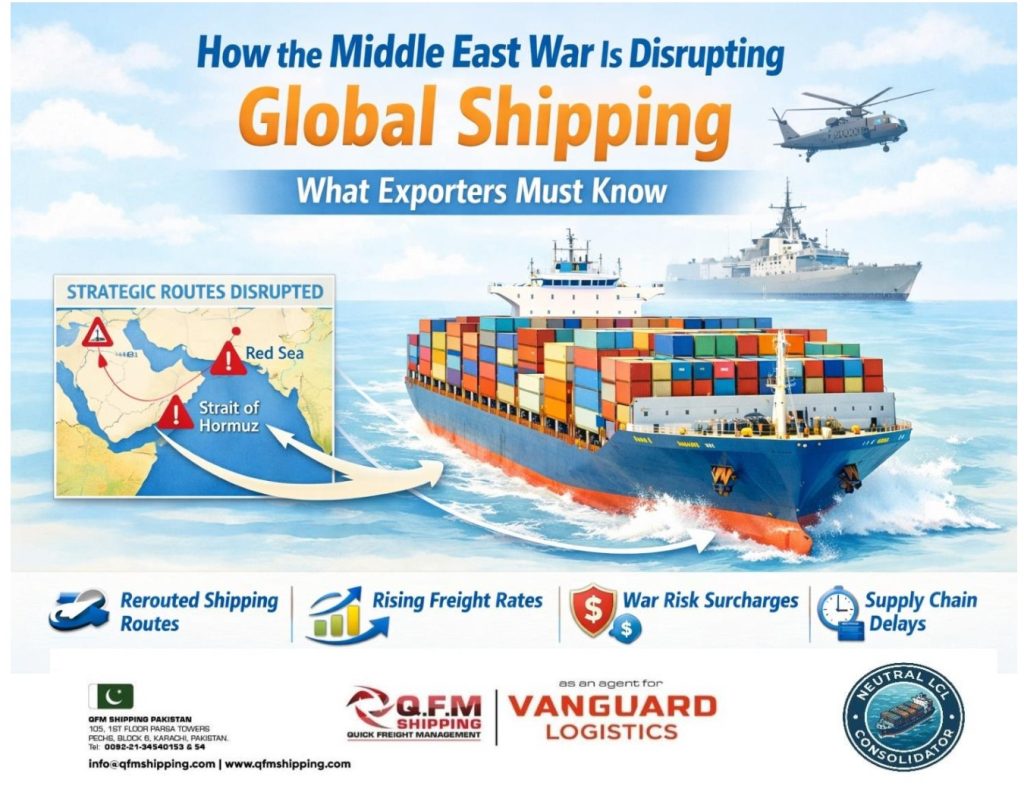
How the Middle East War Is Disrupting Global Shipping — What Exporters Must Know
Global trade depends heavily on stable maritime shipping routes, especially those passing through the Middle East. However, the ongoing conflict in the region has introduced significant uncertainty into international logistics networks.
The Middle East war disrupting global shipping has triggered vessel rerouting, rising insurance premiums, and longer transit times. For exporters, this evolving crisis is not just a geopolitical issue—it directly affects shipping costs, delivery schedules, and supply chain reliability.
Understanding how this disruption impacts logistics is essential for exporters, freight forwarders, and supply chain managers worldwide.
Why the Middle East Is Critical for Global Shipping
The Middle East sits at the center of several of the world’s most strategic maritime trade corridors.
Key shipping chokepoints include:
Strait of Hormuz
-
One of the world’s busiest oil and cargo shipping routes
-
Connects the Persian Gulf with global markets
Red Sea and Bab-el-Mandeb Strait
-
Major route linking Asia to Europe via the Suez Canal
-
Critical for containerized cargo shipments
Suez Canal Trade Corridor
-
Handles roughly 12–15% of global trade
Any instability in these areas can quickly trigger global shipping disruptions, affecting everything from consumer goods to industrial materials.
How the War Is Disrupting Global Shipping
1. Vessel Rerouting and Longer Transit Times
Many shipping companies are avoiding high-risk areas near conflict zones. As a result, vessels are increasingly rerouting around the Cape of Good Hope instead of passing through the Suez Canal.
Impact of rerouting:
-
Transit time increases by 10–15 days
-
Higher fuel consumption
-
Vessel capacity constraints
For exporters, this means longer delivery schedules and potential supply chain delays.
2. Rising Freight Rates
Shipping disruptions almost always lead to freight rate volatility.
Current market impacts include:
-
Emergency congestion surcharges
-
War-risk insurance premiums
-
Equipment shortages in certain ports
Container freight rates on some trade lanes have risen sharply due to capacity constraints and increased operating costs.
Exporters must now plan for higher logistics budgets and fluctuating shipping costs.
3. War-Risk Insurance and Security Surcharges
Shipping lines operating in high-risk zones must pay additional insurance.
These charges often appear as:
-
War risk surcharges
-
Security surcharges
-
High-risk area premiums
These costs are frequently passed on to cargo owners, increasing the total landed cost of goods.
4. Port Congestion and Equipment Imbalance
When vessels reroute or delay departures, ports can quickly become congested.
Common consequences include:
-
Container shortages
-
Delayed vessel schedules
-
Increased port handling costs
The result is greater unpredictability across the global logistics network.
Impact on Exporters and Importers
Exporters are among the most affected by these disruptions.
Key challenges include:
Longer shipping schedules
Products may take weeks longer to reach buyers.
Higher transportation costs
Freight rate increases affect pricing competitiveness.
Inventory management risks
Delayed cargo can disrupt production cycles.
Contractual delivery pressures
Exporters may struggle to meet delivery commitments.
Businesses that rely on just-in-time supply chains are particularly vulnerable.
What Exporters Should Do Now
To navigate the current logistics environment, exporters should adopt proactive supply chain strategies.
1. Plan Shipments Earlier
Allow additional transit time to account for delays caused by rerouting and congestion.
2. Diversify Shipping Routes
Work with freight forwarders to explore alternative routes when possible.
3. Monitor Freight Market Trends
Shipping conditions are evolving rapidly. Exporters must stay informed about rate changes and route disruptions.
4. Work with Reliable Freight Forwarders
Experienced logistics providers can offer guidance on routing, cargo security, and risk mitigation.
5. Consider Flexible Shipping Solutions
Options such as LCL consolidation can provide more flexibility during uncertain shipping conditions.
Opportunities Emerging from the Crisis
While disruptions create challenges, they can also present opportunities.
Regional logistics hubs
Ports in South Asia and the Gulf may gain importance as alternative routing centers.
Digital logistics monitoring
More companies are investing in real-time shipment visibility tools.
Supply chain diversification
Businesses are reevaluating supplier locations and trade routes to reduce risk.
These changes could reshape global logistics networks in the coming years.
The Role of Freight Forwarders in Crisis Management
Freight forwarders play a critical role during shipping disruptions.
They help exporters by:
-
Securing vessel space
-
Providing updated shipping intelligence
-
Managing documentation and customs
-
Optimizing cost-effective routing
Experienced logistics partners can significantly reduce risk during global shipping crises.
Conclusion
The Middle East war disrupting global shipping is creating one of the most significant logistics challenges in recent years. Vessel rerouting, rising freight rates, insurance surcharges, and longer transit times are affecting exporters worldwide.
Businesses involved in international trade must adapt quickly by planning shipments earlier, monitoring logistics trends, and working with experienced freight partners.
Exporters who proactively manage their supply chains will be better positioned to navigate the evolving global shipping landscape.
Tags:
Middle East war shipping disruption, global shipping crisis, freight rate increase, supply chain disruption Middle East, shipping route disruption, exporter logistics risks, maritime security crisis, Pakistan shipping routes, global logistics disruption, QFM Shipping,
