
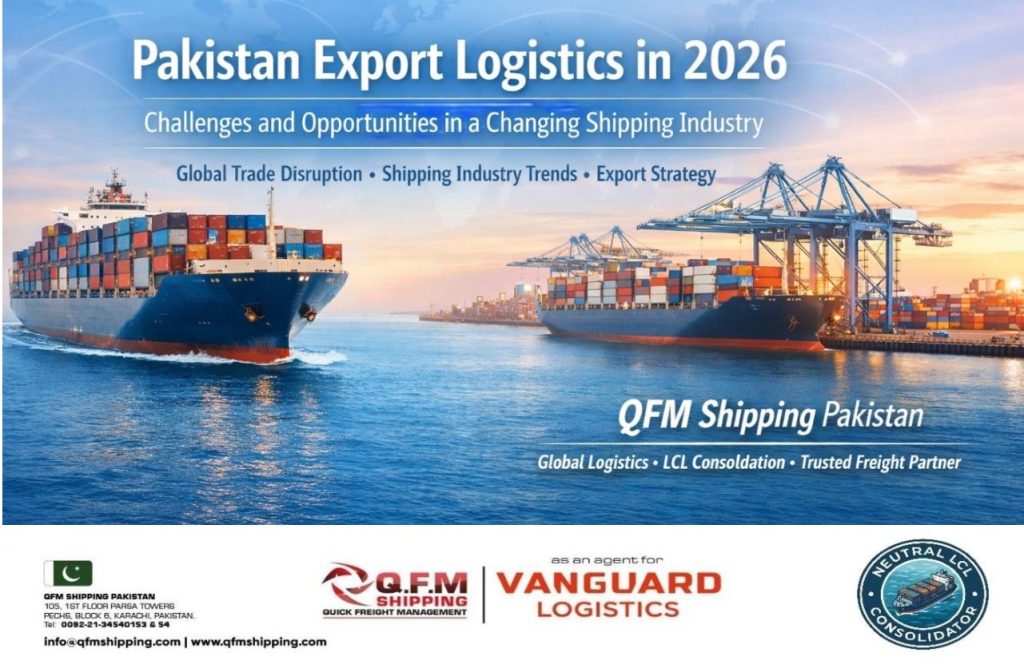
Pakistan export logistics is entering a transformative phase in 2026. Global supply chains continue to evolve due to geopolitical tensions, shifting manufacturing hubs, and changing maritime trade routes. For exporters in Pakistan—especially those in textiles, pharmaceuticals, sports goods, and agricultural products—these changes create both challenges and opportunities.
Recent global trade disruption events, including regional conflicts, shipping lane risks, and port congestion, have forced exporters to rethink their logistics strategies. At the same time, emerging shipping industry trends are creating new opportunities for agile exporters and logistics providers.
In this rapidly evolving environment, companies such as QFM Shipping Pakistan play a critical role in ensuring reliable export logistics through efficient consolidation services, optimized routing, and global connectivity.
The State of Pakistan Export Logistics in 2026
Pakistan’s export sector relies heavily on maritime transportation. Nearly 90% of international trade by volume moves by sea, making maritime logistics the backbone of the country’s export economy.
Key export sectors include:
-
Textiles and garments
-
Surgical instruments
-
Sports goods
-
Leather products
-
Rice and agricultural commodities
However, Pakistan export logistics in 2026 faces several structural and global challenges.
Major Challenges Facing Pakistan Export Logistics
1. Global Trade Disruption and Geopolitical Instability
One of the most significant challenges affecting Pakistan export logistics today is global trade disruption caused by geopolitical tensions.
Recent developments have affected major maritime routes such as:
-
Red Sea shipping lanes
-
Arabian Gulf transit corridors
-
Eastern Mediterranean trade routes
These disruptions lead to:
-
Longer transit times
-
Increased freight costs
-
Vessel rerouting
-
Insurance premium increases
For exporters, these challenges require flexible logistics planning and reliable freight partners.
2. Volatile Freight Rates
Another challenge affecting Pakistan export logistics is fluctuating freight rates.
Over the past few years, the shipping industry has experienced:
-
Sudden freight rate spikes
-
Container shortages
-
Vessel schedule instability
These fluctuations create uncertainty for exporters planning shipments months in advance.
Professional logistics providers like QFM Shipping Pakistan help exporters manage these uncertainties by providing LCL consolidation services and optimized freight solutions.
3. Port Congestion and Infrastructure Constraints
While Pakistan’s major ports—Karachi Port and Port Qasim—handle significant cargo volumes, infrastructure constraints can create bottlenecks during peak seasons.
Common issues include:
-
Terminal congestion
-
Container yard limitations
-
Customs processing delays
Efficient logistics coordination is essential to minimize delays in Pakistan export logistics operations.
Key Shipping Industry Trends Impacting Export Logistics
Despite these challenges, several shipping industry trends are reshaping opportunities for Pakistan exporters.
1. Growth of LCL (Less-than-Container-Load) Shipping
Many exporters—particularly SMEs—cannot fill an entire container. This has increased demand for LCL shipping services.
LCL allows multiple exporters to share container space, offering:
-
Lower shipping costs
-
Flexible cargo volumes
-
Frequent sailings
Through its consolidation network, QFM Shipping Pakistan supports exporters by providing efficient LCL services connecting Pakistan to major global markets.
2. Regional Trade Diversification
Another important shipping industry trend is the diversification of export destinations.
Pakistani exporters are increasingly expanding beyond traditional markets to include:
-
Central Asia
-
Eastern Europe
-
Southeast Asia
-
Gulf Cooperation Council (GCC) countries
This diversification reduces dependency on a single region and strengthens Pakistan export logistics resilience.
3. Digitalization of Logistics
Digital transformation is reshaping how logistics operations are managed.
New technologies now enable:
-
Real-time shipment tracking
-
Digital documentation
-
automated freight management
-
predictive supply chain planning
Digital tools improve transparency and efficiency across Pakistan export logistics networks.
Opportunities for Pakistani Exporters
Despite global uncertainty, 2026 presents significant opportunities for exporters who adapt quickly.
Strategic Location Advantage
Pakistan sits at a key junction between South Asia, the Middle East, and Central Asia.
This strategic location allows exporters to access multiple high-growth markets with competitive transit times.
Growing Demand for Pakistani Products
Global demand remains strong for:
-
Pakistani textiles
-
medical instruments
-
sports equipment
-
rice and food products
Efficient Pakistan export logistics enables exporters to capitalize on these opportunities.
Expansion of Consolidation Hubs
Karachi is emerging as an important regional consolidation hub for cargo moving between Asia, the Middle East, and Europe.
Through global partnerships, QFM Shipping Pakistan supports exporters with efficient consolidation and international connectivity, helping them reach global markets with optimized logistics solutions.
How QFM Shipping Pakistan Supports Exporters
In an increasingly complex logistics environment, exporters require reliable partners with strong global networks.
QFM Shipping Pakistan, as an exclusive agent of Vanguard Logistics, provides:
-
Global LCL consolidation services
-
Competitive sea freight solutions
-
reliable export logistics planning
-
strong international partner networks
-
flexible routing during global trade disruption
These capabilities help exporters maintain supply chain stability even during volatile shipping industry conditions.
The Future of Pakistan Export Logistics
Looking ahead, the future of Pakistan export logistics will be shaped by several factors:
-
continued global trade disruption
-
evolving shipping industry trends
-
digital logistics platforms
-
regional trade expansion
-
stronger logistics infrastructure
Exporters who invest in resilient logistics strategies and work with experienced freight partners will be best positioned to succeed.
Conclusion
Pakistan export logistics in 2026 stand at a critical crossroads. While global trade disruption and operational challenges continue to affect supply chains, emerging shipping industry trends offer new opportunities for growth.
Exporters who adapt to these changes—through smarter routing, consolidation strategies, and strong logistics partnerships—can strengthen their competitiveness in global markets.
With its global network, consolidation expertise, and industry experience, QFM Shipping Pakistan remains committed to supporting exporters in navigating the changing shipping landscape.
Tags:
Pakistan export logistics, global trade disruption, QFM Shipping, shipping industry trends, Pakistan export shipping, logistics in Pakistan, sea freight Pakistan, LCL shipping Pakistan, global supply chain disruption
