
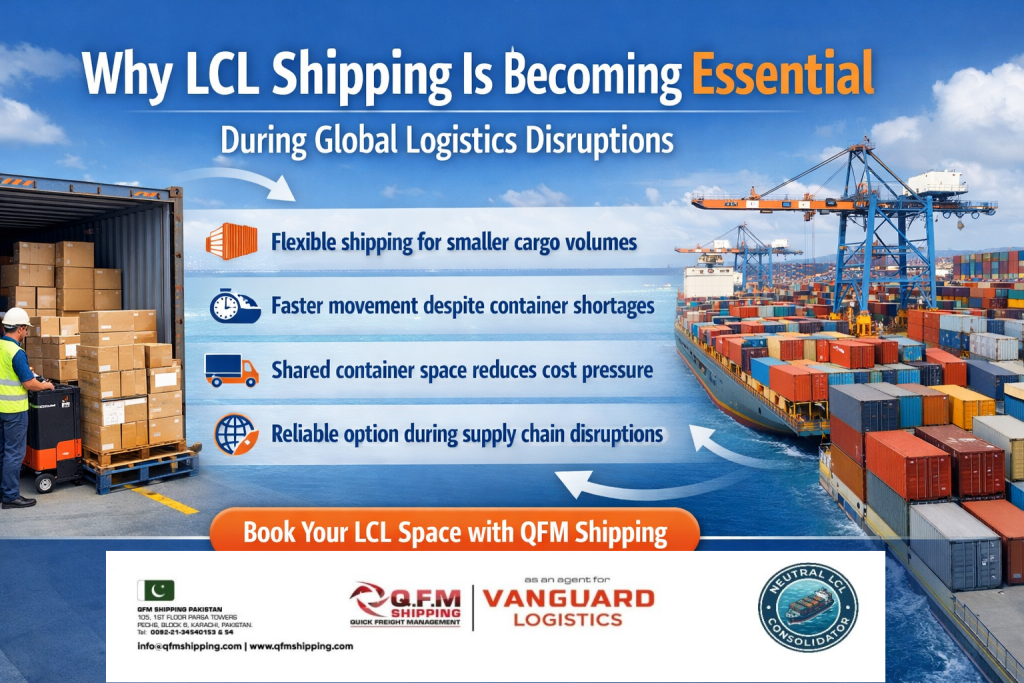
Why LCL Shipping Is Becoming Essential During Global Logistics Disruptions
Global supply chains are facing unprecedented volatility. From geopolitical tensions and port congestion to container shortages and shifting trade routes, global logistics disruptions are now a recurring reality for exporters and importers.
In this evolving environment, LCL shipping (Less-than-Container-Load) is emerging as a critical logistics strategy. Businesses that previously relied on full container loads are increasingly turning to LCL shipping to maintain supply chain continuity, reduce risk, and remain competitive in global trade.
For companies navigating uncertainty in international shipping, LCL consolidation offers flexibility, cost efficiency, and operational resilience.
Understanding LCL Shipping
LCL shipping (Less-than-Container-Load) allows multiple shippers to share space in a single ocean container. Instead of waiting until a company has enough cargo to fill a full container (FCL), shipments can be consolidated with cargo from other exporters.
Freight forwarders and neutral consolidators handle the process by:
-
Combining shipments from multiple clients
-
Packing cargo efficiently into containers
-
Managing documentation and customs processes
-
Delivering shipments to multiple destinations
This shared container model enables companies to ship smaller cargo volumes while maintaining access to global trade lanes.
The Rising Impact of Global Logistics Disruptions
The international shipping industry has experienced multiple disruptions in recent years, including:
Geopolitical Conflicts
Conflicts affecting key maritime regions can disrupt major shipping routes, forcing carriers to reroute vessels and increase transit times.
Port Congestion
Major ports worldwide regularly experience congestion due to increased trade volumes, labor shortages, and operational inefficiencies.
Container Shortages
Imbalances in global container distribution have caused shortages in export hubs, making it difficult for shippers to secure full containers.
Rising Freight Costs
Freight rates fluctuate significantly during disruptions, increasing the financial pressure on exporters.
In such conditions, businesses require agile shipping solutions, and this is where LCL shipping becomes essential.
Why LCL Shipping Is Becoming Essential
1. Flexibility for Smaller Shipments
One of the biggest advantages of LCL shipping is flexibility. Exporters can ship smaller quantities without waiting to accumulate enough cargo to fill a container.
This is particularly important for:
-
SMEs entering international markets
-
Businesses shipping sample consignments
-
Seasonal or variable export volumes
LCL shipping allows companies to maintain consistent supply chains even during volatile market conditions.
2. Faster Supply Chain Movement
During logistics disruptions, waiting to fill a container can cause costly delays. LCL shipments allow cargo to move immediately through consolidated containers.
This helps businesses:
-
Reduce storage time
-
Avoid missed delivery deadlines
-
Maintain production schedules
In industries where timing is critical, LCL shipping improves supply chain agility.
3. Cost Efficiency During Market Volatility
Freight rates can surge dramatically during supply chain disruptions. For companies shipping smaller volumes, booking a full container may not be financially viable.
LCL shipping enables businesses to:
-
Pay only for the space they use
-
Avoid underutilized containers
-
Optimize logistics costs
This shared cost model helps exporters control expenses during uncertain market conditions.
4. Reduced Risk in Uncertain Trade Environments
Diversifying shipments through LCL can reduce logistics risk. Instead of relying on large shipments in single containers, businesses can distribute cargo across multiple consolidated shipments.
This approach provides:
-
Greater shipment flexibility
-
Reduced financial exposure
-
Improved supply chain resilience
As disruptions become more frequent, risk management is becoming a core logistics strategy.
5. Access to Global Trade Routes
LCL consolidation services provide access to major international shipping routes even for small cargo volumes.
Through global consolidation networks, freight forwarders connect exporters with key markets such as:
-
Europe
-
Middle East
-
Asia
-
North America
For many businesses, LCL shipping is the gateway to global trade expansion.
The Role of Neutral LCL Consolidators
Neutral LCL consolidators play a critical role in making LCL shipping efficient and reliable.
These operators specialize in:
-
Cargo consolidation
-
Route optimization
-
Customs documentation
-
Warehouse handling
-
Destination deconsolidation
By working with neutral consolidators, freight forwarders can provide global LCL services without maintaining their own consolidation infrastructure.
QFM Shipping Pakistan: Supporting Global Trade Through LCL Solutions
As an exclusive agent of Vanguard Logistics, QFM Shipping Pakistan provides reliable LCL consolidation services connecting Pakistan to major global markets.
QFM Shipping offers:
-
Neutral LCL consolidation
-
Global shipping network access
-
Reliable sailing schedules
-
Efficient cargo handling
-
Professional freight forwarding support
With extensive experience in international logistics, QFM Shipping helps exporters and freight forwarders navigate global disruptions while maintaining efficient cargo movement.
The Future of LCL Shipping
Industry analysts expect LCL shipping to play an even larger role in global logistics in the coming years.
Key trends supporting this shift include:
-
Growth of SME exporters
-
Increased e-commerce cross-border trade
-
Volatile freight markets
-
Supply chain diversification strategies
Businesses are increasingly prioritizing flexibility, cost control, and resilience, making LCL shipping a strategic logistics solution rather than just an alternative to full containers.
Conclusion
As global logistics disruptions continue to reshape international trade, LCL shipping has become an essential tool for exporters and importers.
By offering flexibility, cost efficiency, and supply chain resilience, LCL consolidation enables businesses to maintain steady cargo movement even during uncertain market conditions.
Companies that integrate LCL shipping into their logistics strategy will be better positioned to adapt to evolving global trade challenges.
QFM Shipping Pakistan continues to support exporters, importers, and freight forwarders with reliable LCL consolidation services and global logistics connectivity.
Smooth Cargo Movement with QFM Pakistan
QFM Shipping Pakistan
Karachi : Suite # 104 & 105, 1st Floor Parsa Towers PECHS Block 6 Karachi
Tel: 0092-21-34540153 & 54
Lahore: Suite # 1617, 16th Floor, Al Hafeez Executive Gulberg III, Lahore
Tel: 0092-42-35772611 & 12
Email: pricing.pkkhi@qfmshipping.com
Mobile: 0092-321-8280327
Tags:
LCL shipping, Less than Container Load shipping, global logistics disruptions, LCL consolidation services, freight forwarding solutions, shipping industry disruptions, container shortage logistics, flexible cargo shipping, LCL freight solutions, QFM Shipping Pakistan
