
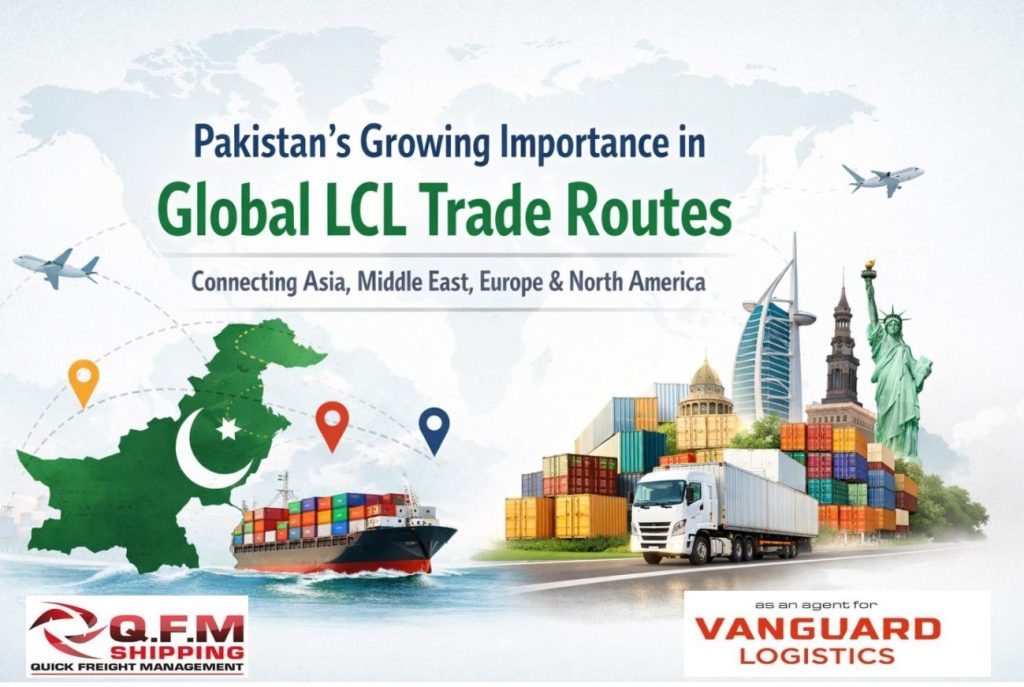
Pakistan’s Growing Importance in Global LCL Trade Lanes
A Strategic Shift in Global Trade
Global shipping dynamics are undergoing a structural transformation, and Pakistan LCL trade routes are emerging as a critical backbone for international logistics. As supply chains diversify and exporters seek cost-efficient solutions, Less-than-Container-Load (LCL) shipping is gaining unprecedented traction.
Pakistan, with its strategic geographic location and expanding export base, is rapidly becoming a key node in global LCL trade lanes—connecting Asia, the Middle East, Europe, and North America.
Why Pakistan LCL Trade Routes Are Gaining Global Attention
1. Strategic Geographic Advantage
Pakistan sits at the crossroads of major global shipping corridors:
- Gateway between South Asia, Middle East, and Central Asia
- Direct access to Arabian Sea trade routes
- Strong connectivity via Port of Karachi and Port Qasim
This positioning enhances the efficiency of Pakistan LCL trade routes, making them highly attractive for international consolidators and exporters.
2. Rising Export Volumes
Pakistan’s export sectors are expanding rapidly:
- Textiles and garments
- Surgical instruments
- Leather goods
- Sports equipment
With increasing shipment frequency and smaller order sizes, exporters prefer Pakistan LCL trade routes to optimize costs and flexibility.
3. Cost Efficiency Driving LCL Demand
LCL shipping enables businesses to:
- Avoid full container costs
- Ship smaller volumes more frequently
- Reduce inventory holding risks
This is why Pakistan LCL trade routes are becoming the preferred choice for SMEs and growing exporters.
Key Pakistan LCL Trade Routes Powering Global Trade
1. Jebel Ali (UAE) – Karachi
One of the most active corridors:
- Serves as a GCC–Pakistan gateway
- High-frequency consolidations
- Strong re-export activity
2. Singapore – Karachi
A vital Southeast Asia link:
- Connects ASEAN markets
- Efficient for electronics and mixed cargo
- Strengthens Asia-Pacific trade via Pakistan LCL trade routes
3. China – Karachi
Critical for imports and reverse logistics:
- Supports CPEC-driven trade flows
- High volume of industrial and consumer goods
- Increasing role in Pakistan LCL trade routes
4. Karachi – Hamburg (Europe)
Key export lane:
- Textile and apparel exports
- Access to EU distribution hubs
- Growing demand for consolidated cargo shipments
5. USA & Canada Trade Lanes
Expanding rapidly:
- Rising Pakistani exports to North America
- Demand for reliable LCL consolidation
- Strong growth in Pakistan LCL trade routes
The Role of Neutral LCL Consolidation in Pakistan
A major factor behind the success of Pakistan LCL trade routes is the rise of neutral freight forwarding models.
Why Neutral LCL Matters:
- Protects agent confidentiality
- Enables global partnerships
- Ensures fair competition
- Improves cargo consolidation efficiency
Neutral consolidators are strengthening Pakistan’s position in global LCL ecosystems.
Challenges Facing Pakistan LCL Trade Routes
Despite strong growth, several challenges remain:
1. Infrastructure Constraints
- Port congestion
- Inland transportation inefficiencies
2. Global Disruptions
- War-related rerouting
- Fuel price volatility
- Freight rate fluctuations
3. Compliance & Documentation
- Complex export procedures
- Regulatory delays
However, these challenges are being actively addressed, further strengthening Pakistan LCL trade routes.
How QFM Shipping Pakistan Is Driving LCL Excellence
As a trusted logistics partner, QFM Shipping Pakistan plays a pivotal role in optimizing Pakistan LCL trade routes.
QFM Shipping Pakistan Advantages:
- Strong global network of agents
- Reliable LCL consolidation services
- Competitive freight rates
- Expertise in GCC, Europe, and Asia trade lanes
- Neutral consolidation capabilities
- Real-time shipment tracking
QFM ensures that exporters leverage Pakistan LCL trade routes with maximum efficiency and minimal risk.
Future Outlook: Pakistan as a Global LCL Hub
The future of Pakistan LCL trade routes is highly promising:
- Growth in e-commerce exports
- Increasing SME participation in global trade
- Expansion of regional trade agreements
- Investment in port infrastructure
- Digitalization of logistics operations
Pakistan is on track to become a major LCL consolidation hub in South Asia.
Conclusion: A Strategic Opportunity for Exporters
The rise of Pakistan LCL trade routes is not just a trend—it’s a structural shift in global logistics. Exporters who adapt early can unlock:
- Cost savings
- Faster market access
- Flexible shipping strategies
With the right logistics partner like QFM Shipping Pakistan, businesses can fully capitalize on these evolving opportunities.
Call to Action
Ready to optimize your shipments through Pakistan LCL trade routes?
Partner with QFM Shipping Pakistan for reliable, cost-effective, and globally connected LCL solutions.
👉 Contact us today to book your next LCL shipment
 Book your next LCL shipment with a trusted neutral partner
QFM Shipping Pakistan
Your Trusted Neutral LCL Consolidation Partner
 Contact us |
  Global Reach |
  Reliable Partnerships
It’s time to move with QFM Shipping Pakistan.
Move Smarter. Ship with Confidence.
QFM Shipping Pakistan
Karachi : Suite # 104 & 105, 1st Floor Parsa Towers PECHS Block 6 Karachi
Tel: 0092-21-34540153 & 54
Lahore: Suite # 1617, 16th Floor, Al Hafeez Executive Gulberg III, Lahore
Tel: 0092-42-35772611 & 12
Email: pricing.pkkhi@qfmshipping.com
Mobile: 0092-321-8280327
Tags:
Pakistan LCL trade routes, LCL shipping Pakistan, Pakistan export logistics, QFMShipping, freight consolidation Pakistan, global LCL trade lanes, Karachi LCL shipping, Pakistan freight forwarder, neutral LCL Pakistan, international LCL shipping Pakistan
