
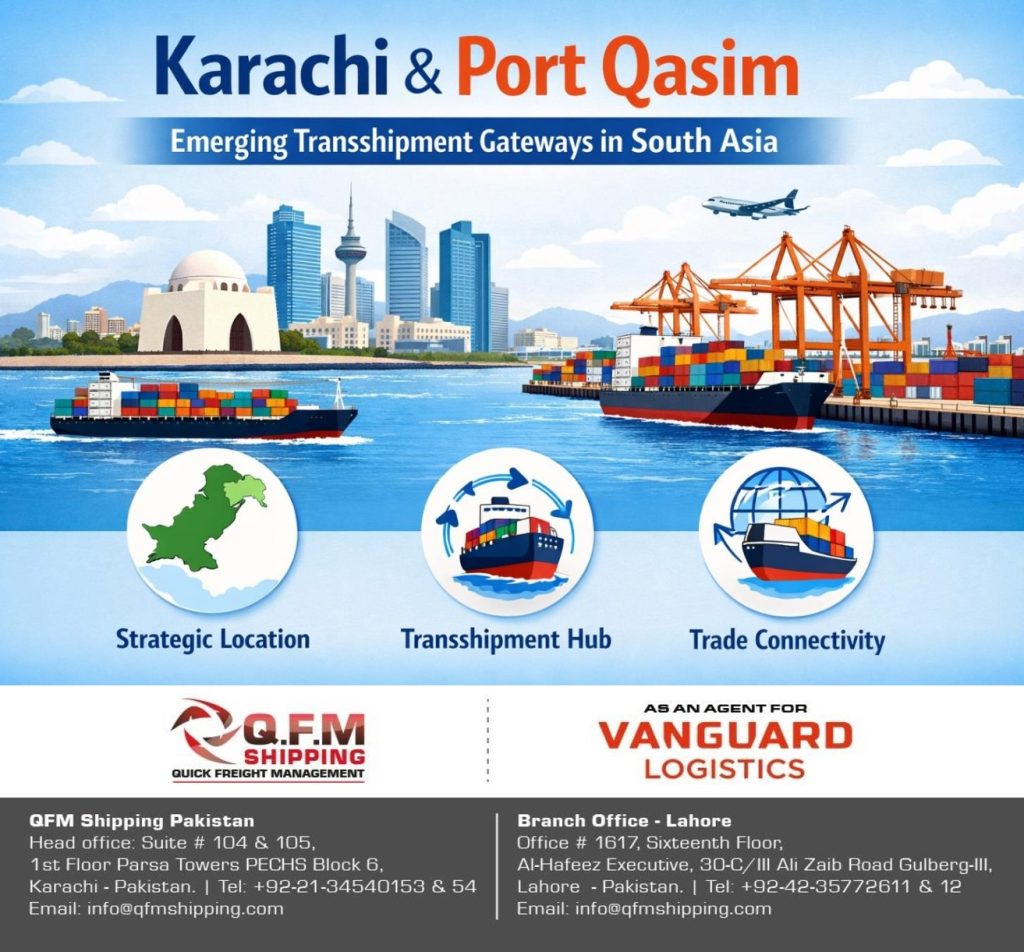
Karachi & Port Qasim | Emerging Transshipment Gateways in South Asia
A Strategic Shift in South Asian Logistics
The global logistics landscape is undergoing a major transformation, driven by geopolitical disruptions, rising freight costs, and shifting trade routes. In this evolving environment, Karachi Port and Port Qasim are rapidly emerging as powerful transshipment hubs in South Asia.
The rise of Karachi Port Qasim transshipment is not just a regional development—it is a strategic opportunity for global shippers, freight forwarders, and exporters looking for alternative, reliable, and cost-effective routes.
With Pakistan’s recent regulatory reforms and growing infrastructure capabilities, these ports are now positioned to compete with established hubs like Jebel Ali Port and Colombo Port.
Karachi Port: Pakistan’s Historic Trade Gateway


Why Karachi Port Matters
Located in the heart of Pakistan’s commercial capital Karachi, Karachi Port has long served as the backbone of the country’s maritime trade.
Key Advantages
- Strategic proximity to major trade routes connecting Asia, Middle East, and Africa
- Established infrastructure with multiple container terminals
- Strong connectivity to inland transport networks
- Increasing role in Karachi Port Qasim transshipment operations
Emerging Role in Transshipment
With new policy support, Karachi Port is now handling:
- LCL consolidation for GCC markets
- Transit cargo for regional redistribution
- Neutral freight forwarding operations
This evolution is positioning Karachi as a viable alternative to congested regional hubs.
Port Qasim: The Modern Logistics Powerhouse

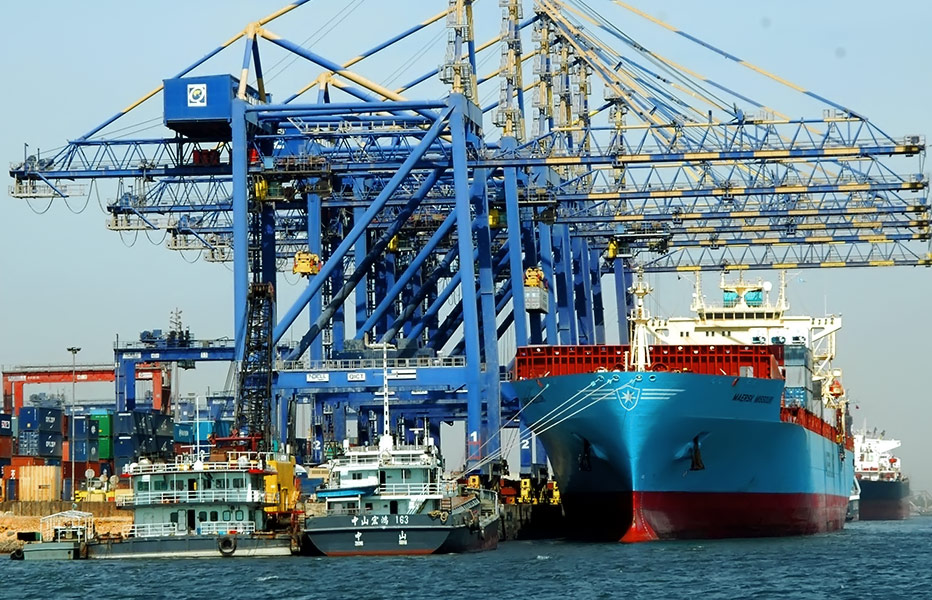
A Port Built for Efficiency
Port Qasim is Pakistan’s second-largest port and one of the most modern maritime facilities in the region.
Key Strengths
- Deep-water berths capable of handling large vessels
- Modern cargo handling systems
- Direct access to industrial zones
- Reduced congestion compared to traditional ports
Transshipment Potential
Port Qasim is increasingly becoming central to Karachi Port Qasim transshipment, offering:
- Faster vessel turnaround times
- Scalable infrastructure for LCL and FCL cargo
- Cost-efficient routing for Middle East-bound shipments
Why Karachi & Port Qasim Are Emerging as Transshipment Hubs
1. Strategic Geographic Location
Pakistan sits at the crossroads of major global shipping lanes:
- Close to the Middle East (UAE, Oman, KSA)
- Direct access to South Asia and Central Asia
- Alternative routing option amid regional instability
2. Policy Support & Regulatory Reforms
The introduction of transshipment-friendly policies (e.g., SRO 525(I)/2026) has:
- Enabled international LCL transshipment
- Simplified customs procedures
- Encouraged foreign logistics partnerships
3. Cost Efficiency
Compared to traditional hubs:
- Lower port handling charges
- Competitive freight rates
- Reduced congestion delays
4. Growing Demand for Alternative Routes
With disruptions in traditional shipping corridors:
- Shippers are diversifying logistics strategies
- Pakistan offers a stable and emerging alternative
Comparison with Regional Transshipment Hubs
| Factor | Karachi & Port Qasim | Jebel Ali | Colombo |
|---|---|---|---|
| Cost Efficiency | High | Medium | Medium |
| Congestion | Low–Medium | High | Medium |
| Growth Potential | Very High | Mature | High |
| Strategic Position | Emerging | Established | Established |
Pakistan’s ports are not yet replacements—but they are high-potential complementary hubs.
Role of QFM Shipping Pakistan in This Transformation
As Pakistan evolves into a transshipment hub, QFM Shipping Pakistan is playing a critical role in enabling this shift.
How QFM Adds Value
- Neutral LCL consolidation services
- Strong global partner network
- Efficient cargo handling through Karachi & Port Qasim
- Reliable routing to GCC markets
For Exporters & Forwarders
QFM Shipping provides:
- Faster transit options
- Secure cargo handling
- Competitive pricing models
- Flexible logistics solutions
This makes QFM a strategic logistics partner in the era of Karachi Port Qasim transshipment.
Industries Benefiting from This Shift
The rise of Karachi and Port Qasim is transforming multiple sectors:
- Textiles & Apparel → Faster exports to GCC & Europe
- Pharmaceuticals → Reliable cold-chain logistics
- Automotive Parts → Efficient regional redistribution
- Consumer Goods → Improved supply chain resilience
Challenges to Address
Despite strong growth, some challenges remain:
- Infrastructure scalability
- Digitalization of port operations
- Global perception and awareness
- Competition from established hubs
However, these are transitional challenges, not structural limitations.
Future Outlook: Pakistan as a Regional Logistics Hub
The trajectory is clear:
- Increasing global interest in Pakistan’s logistics
- Expansion of port capabilities
- Stronger integration with global supply chains
In the coming years, Karachi Port Qasim transshipment could become a cornerstone of South Asian logistics.
Conclusion
Karachi Port and Port Qasim are no longer just national assets—they are evolving into strategic transshipment gateways for global trade.
With the right combination of:
- Policy support
- Geographic advantage
- Cost efficiency
- Logistics expertise from partners like QFM Shipping
Pakistan is poised to become a key player in the future of global logistics.
Call to Action
Looking to optimize your cargo routes?
Partner with QFM Shipping Pakistan and obtain the power of Karachi & Port Qasim transshipment for faster, smarter, and more reliable logistics.
Move Smarter. Ship with Confidence.
QFM Shipping Pakistan
Karachi : Suite # 104 & 105, 1st Floor Parsa Towers PECHS Block 6 Karachi
Tel: 0092-21-34540153 & 54
Lahore: Suite # 1617, 16th Floor, Al Hafeez Executive Gulberg III, Lahore
Tel: 0092-42-35772611 & 12
Email: pricing.pkkhi@qfmshipping.com
Mobile: 0092-321-8280327
Tags:
Karachi Port Qasim transshipment, Pakistan transshipment hub, South Asia logistics gateway, Karachi Port LCL, Port Qasim logistics, Pakistan shipping routes, GCC cargo transshipment, neutral consolidation Pakistan
Read More:
Neutral freight forwarder Pakistan
