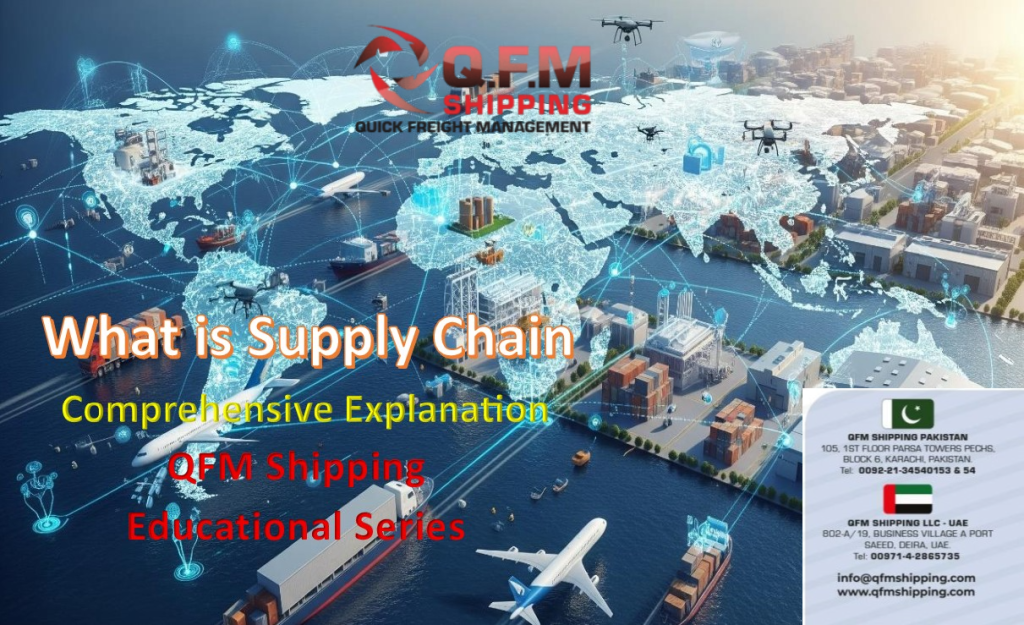
What is Supply Chain
Target Audience: Students, business professionals, anyone interested in how products and services reach them.
Learning Objectives:
- Define what a supply chain is in simple terms.
- Identify the key elements that make up a supply chain.
- Understand the flow of goods, information, and money within a supply chain.
- Appreciate the importance of an effective supply chain in modern business and everyday life.
Introduction: What is a Supply Chain?
Have you ever wondered how your favorite snack, your smartphone, or even the shirt you’re wearing got to you? It wasn’t magic! Behind every product and service we consume lies a complex, interconnected system called the Supply Chain.
In its simplest definition, a Supply Chain is:
“The network of organizations, resources, activities, and information involved in the production, distribution, and delivery of goods or services to customers. It encompasses everything from raw materials to the end consumer.”
Think of it as a grand relay race. Each participant (organization, resource, activity) passes the “baton” (product or service) along, adding value at each stage, until it reaches the finish line – you, the customer.
Deconstructing the Definition | Key Elements of a Supply Chain
Let’s break down the core components mentioned in our definition:
- Network of Organizations:
- A supply chain is rarely just one company. It’s a collaboration (or competition!) between many independent entities.
- Examples: Raw material suppliers, component manufacturers, finished product assemblers, transportation companies, warehouses, distributors, retailers, and even recycling centers.
- Resources:
- These are the tangible and intangible assets needed to make and move products.
- Examples:
- Physical: Raw materials (e.g., crude oil, cotton, silicon), machinery, factories, warehouses, vehicles (trucks, ships, planes), land.
- Human: Laborers, engineers, logistics managers, sales teams.
- Financial: Capital for investments, operational costs, payments.
- Activities:
- These are the processes and operations that transform and move products along the chain.
- Examples: Sourcing raw materials, manufacturing, assembling, packaging, storing, loading, transporting, unloading, marketing, selling, customer service.
- Information:
- This is the lifeblood of the supply chain. Accurate and timely information ensures everything runs smoothly.
- Examples: Sales forecasts, order details, inventory levels, production schedules, shipping updates, tracking numbers, payment confirmations, quality control reports, customer feedback.
- Think: Without knowing how much product a customer needs, how can a factory know how much to produce? Without tracking information, how do you know where your package is?
- Flow of Goods or Services:
- This is the most visible aspect – the physical movement of products.
- Goods: From basic raw materials (like ore) to semi-finished goods (like steel sheets) to finished products (like cars).
- Services: While less tangible, services also have supply chains. For example, a consulting service supply chain might involve research, expert collaboration, presentation development, and delivery.
- From Raw Materials to the End Consumer:
- This highlights the end-to-end nature of the supply chain. It covers every step.
- Raw Materials: The most basic components from which a product is made (e.g., timber for furniture, plastic pellets for toys, coffee beans for a latte).
- End Consumer: The final person or entity who uses the product or service.
The Interconnected Flows within a Supply Chain
Beyond just goods, three crucial “flows” define how a supply chain operates:
- The Product Flow (Forward & Reverse):
- Forward Flow: The traditional movement of goods from raw material suppliers through manufacturing, distribution, and ultimately to the customer.
- Reverse Flow (Reverse Logistics): The movement of goods back from the customer for returns, repairs, recycling, or disposal. This is an increasingly important part of modern supply chains.
- The Information Flow:
- This is bidirectional and critical. It includes orders, forecasts, production plans, inventory data, shipping notices, tracking information, and customer feedback.
- Example: A customer placing an order (information from customer), which triggers a production order (information to factory), which triggers a raw material order (information to supplier), and then a shipping notification (information to customer).
- The Financial Flow:
- This is primarily the flow of money, typically in the opposite direction of the goods.
- Example: Customer pays retailer, retailer pays distributor, distributor pays manufacturer, manufacturer pays supplier. It also includes credit terms, payment schedules, and financial agreements.
A Simple Example: The Journey of a T-Shirt
Let’s trace the supply chain of a basic cotton T-shirt:
- Raw Material Sourcing: A farmer grows cotton (raw material).
- Processing: The cotton is harvested and sent to a mill to be cleaned, spun into yarn, and then woven into fabric.
- Manufacturing: The fabric is sent to a garment factory where it’s cut, sewn, dyed, and possibly printed into T-shirts.
- Packaging: T-shirts are folded, tagged, and packed into boxes.
- Warehousing/Distribution: Boxes of T-shirts are sent to a central distribution center (warehouse).
- Transportation (Wholesale/Retail): From the distribution center, trucks or trains move the boxes to various retail stores or e-commerce fulfillment centers.
- Retail/Online Sales: The T-shirt is displayed in a store or listed online.
- Customer Purchase: You buy the T-shirt!
- Reverse Logistics (if applicable): If you return the T-shirt, it travels back through parts of the chain for processing.
At each step, there’s a flow of information (e.g., “order 10,000 yards of fabric”), resources (e.g., labor, machinery), and money changing hands.
Why is Understanding the Supply Chain Important?
A well-managed supply chain is crucial for several reasons:
- Cost Efficiency: Minimizes expenses in production, inventory, and transportation, leading to lower prices for consumers.
- Customer Satisfaction: Ensures products are available when and where customers want them, in the right condition.
- Competitive Advantage: Companies with superior supply chains can offer faster delivery, better quality, or more reliable service than competitors.
- Risk Management: Helps businesses prepare for and respond to disruptions like natural disasters, geopolitical events, or sudden changes in demand.
- Sustainability: Enables ethical sourcing, reduces waste, and helps companies achieve environmental goals.
- Innovation: Allows for faster introduction of new products to the market.
Conclusion: The Invisible Hand Behind Every Product
The supply chain is often an “invisible hand” that works tirelessly behind the scenes, yet it directly impacts our daily lives and the success of every business. From the smallest local shop to global corporations, understanding and optimizing the supply chain is paramount. It’s a dynamic, ever-evolving network that requires constant management and adaptation to deliver value to customers efficiently and effectively.
Global shipping, made local. Global logistics, made simple.
That’s the QFM Shipping promise.
Contact QFM Shipping today and experience logistics reimagined.
