
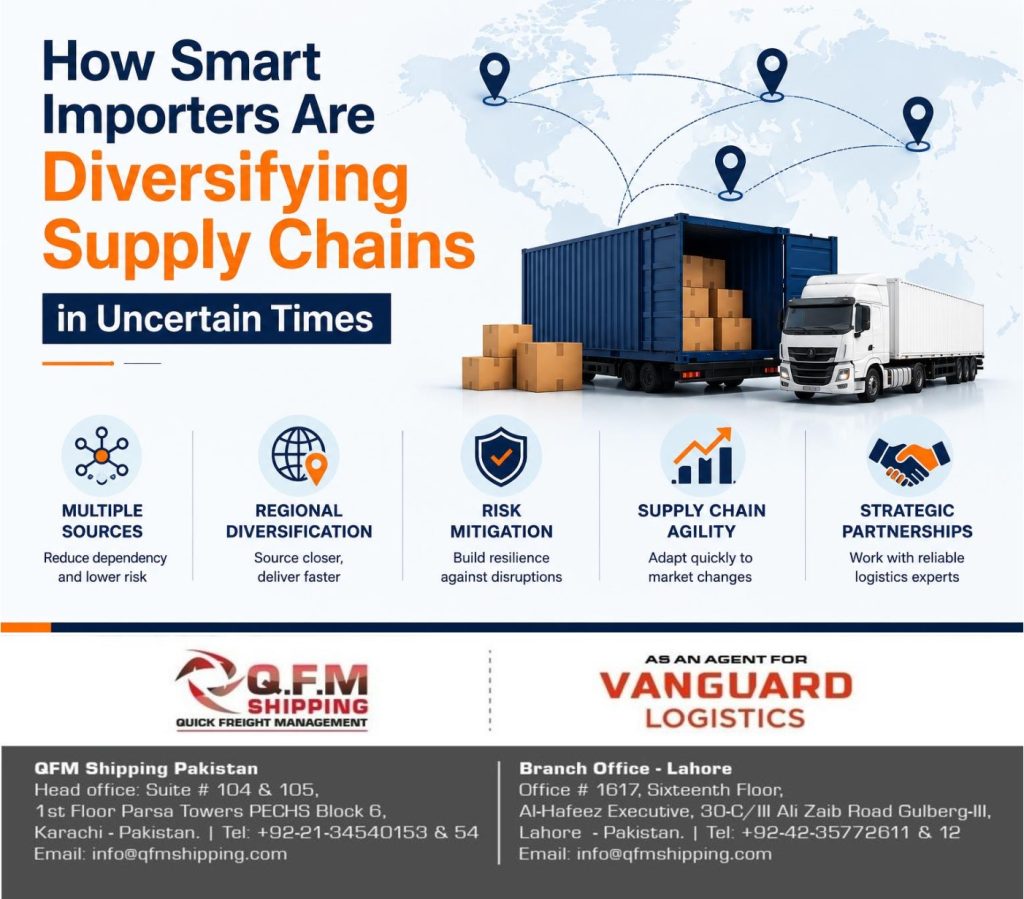
How Smart Importers Are Diversifying Supply Chains in Uncertain Times
Global trade has entered a new era.
For years, businesses focused primarily on:
- Lower production costs
- Bulk purchasing
- Single-source efficiency
But in today’s environment, uncertainty has become a constant part of international trade.
From geopolitical instability to freight disruptions and changing regulations, importers are now realizing a critical truth:
A supply chain that is efficient but fragile is no longer sustainable.
This is why smart importers are actively diversifying supply chains to build resilience, flexibility, and long-term growth.
What Supply Chain Diversification Really Means
Supply chain diversification is the strategy of reducing dependency on:
- A single supplier
- One sourcing country
- One shipping route
- One logistics solution
Instead, businesses create:
✔ Multiple sourcing options
✔ Flexible shipping strategies
✔ Alternative logistics routes
✔ Stronger risk management systems
The goal is simple:
👉 Keep cargo moving—even during disruptions.
Why Importers Are Changing Their Strategies
Modern supply chains face growing risks such as:
- Port congestion
- Geopolitical uncertainty
- Rising freight costs
- Regulatory changes
- Climate-related disruptions
- Supplier instability
Businesses that depend on one source are highly exposed when disruptions occur.
Result:
- Delayed shipments
- Inventory shortages
- Revenue loss
- Increased operational costs
How Smart Importers Are Diversifying Successfully
1- Multi-Supplier Sourcing
Leading importers no longer rely on one supplier or region.
Instead, they:
- Source from multiple countries
- Develop backup suppliers
- Balance regional sourcing strategies
This reduces dependency and improves continuity.
2- Regional Diversification
Many companies are adopting:
- Nearshoring
- Regional sourcing
- Multi-country procurement strategies
This improves:
- Delivery speed
- Risk distribution
- Supply chain flexibility
3- Flexible Shipping Models Like LCL
Rigid bulk shipping strategies are becoming less effective in uncertain markets.
Smart importers now use:
- LCL (Less than Container Load) shipping
- Smaller, more frequent shipments
- Flexible inventory replenishment
👉 Benefits include:
✔ Lower inventory pressure
✔ Faster response to demand changes
✔ Reduced disruption impact
Related: When LCL Becomes Faster Than FCL (Internal Link)
4- Building Strategic Logistics Partnerships
Diversification is not only about suppliers—it’s also about logistics capability.
Experienced logistics providers like QFM Shipping help businesses:
- Identify alternative shipping routes
- Improve cargo visibility
- Reduce operational risks
- Create resilient import strategies
As the exclusive agent of Vanguard Logistics in Pakistan, QFM Shipping connects importers to a powerful global LCL consolidation network.
5- Using Real-Time Data & Visibility
Modern supply chains rely heavily on:
- Shipment tracking
- Predictive planning
- Real-time logistics visibility
Visibility allows importers to:
- React faster
- Plan smarter
- Reduce uncertainty
Real-World Example
Scenario:
An importer sourcing products from one overseas supplier experienced severe delays during regional shipping disruptions.
Strategy Shift:
The company:
- Added suppliers in multiple regions
- Used LCL shipping for flexibility
- Diversified shipping routes
Outcome:
✔ Faster inventory recovery
✔ Reduced shipment delays
✔ Improved business continuity
✔ Greater operational resilience
Common Mistakes Importers Still Make
Many businesses continue to:
❌ Depend on one supplier
❌ Focus only on the lowest freight cost
❌ Ignore contingency planning
❌ Delay logistics diversification
These strategies create vulnerable supply chains.
Why Diversification Matters More in 2026
Global logistics is becoming:
- More dynamic
- More regionalized
- More risk-sensitive
Importers who diversify today gain:
✔ Better flexibility
✔ Faster adaptation
✔ Reduced disruption exposure
✔ Long-term competitive advantage
Why Choose QFM Shipping?
QFM Shipping helps businesses build smarter, more resilient supply chains through:
✔ Global LCL consolidation services
✔ Flexible logistics solutions
✔ Alternative routing strategies
✔ Risk-managed cargo planning
✔ Worldwide network support through Vanguard Logistics
Our focus is simple:
Help businesses move cargo with confidence in uncertain times.
Future-Proof Your Supply Chain Today
The businesses that succeed in modern global trade are not the ones avoiding change—
👉 They are the ones adapting faster than everyone else.
Ready to strengthen your import strategy?
👉 Request a Logistics Consultation
👉 Explore Flexible Shipping Solutions
👉 Build a More Resilient Supply Chain
Conclusion
Supply chain diversification is no longer optional—it is a strategic necessity.
By combining:
- Multiple sourcing strategies
- Flexible shipping models
- Strong logistics partnerships
- Real-time visibility
Businesses can reduce risk while improving long-term growth potential.
And with QFM Shipping and Vanguard Logistics supporting your operations, your supply chain becomes more adaptable, resilient, and future-ready.
Let’s Move Your Business Forward
Ready to take your logistics to the next level?
 Request a Shipping Quote Talk to a Logistics Expert Optimize Your Supply Chain Today
QFM Shipping Pakistan
Karachi : Suite # 104 & 105, 1st Floor Parsa Towers PECHS Block 6 Karachi
Tel: 0092-21-34540153 & 54
Lahore: Suite # 1617, 16th Floor, Al Hafeez Executive Gulberg III, Lahore
Tel: 0092-42-35772611 & 12
Email: pricing.pkkhi@qfmshipping.com
Mobile: 0092-321-8280327
FAQ
Q1: What is supply chain diversification?
It is the process of reducing dependency on one supplier, route, or region by creating multiple sourcing and logistics options.
Q2: Why are businesses diversifying supply chains?
To reduce disruption risk, improve flexibility, and maintain stable operations during uncertainty.
Q3: How does LCL shipping support supply chain diversification?
LCL allows flexible, smaller shipments that improve inventory flow and reduce dependency on bulk shipping schedules.
Tags:
Diversifying supply chains, diversifying supply chains, supply chain resilience, import risk management, global sourcing strategy, flexible logistics solutions, LCL shipping strategy, supplier diversification, global trade strategy,
