
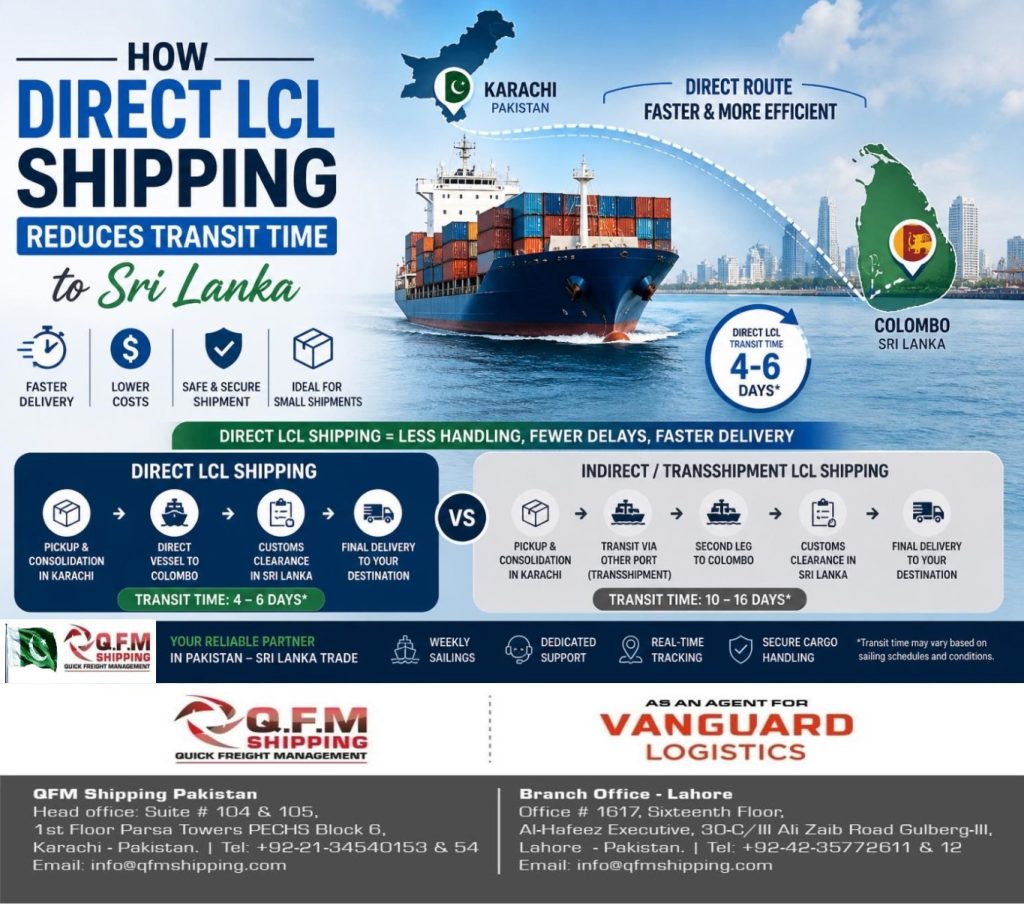
Faster, Smarter Cargo Movement from Pakistan to Colombo
In today’s competitive trade environment, speed is no longer just an advantage — it is a necessity. Importers and exporters shipping between Pakistan and Sri Lanka are increasingly searching for logistics solutions that combine affordability with faster delivery timelines. This is where Direct LCL (Less-than-Container Load) Shipping becomes a game-changer.
For SMEs, traders, manufacturers, and growing businesses, direct LCL shipping from Pakistan to Sri Lanka offers a highly efficient alternative to traditional transshipment-based cargo movement. By reducing unnecessary handling, avoiding multiple port stops, and streamlining consolidation processes, direct LCL services significantly cut transit time while improving cargo reliability.
At QFM Shipping, we provide direct LCL shipment solutions from Pakistan to Sri Lanka designed to help businesses move cargo faster, safer, and more cost-effectively.
What is Direct LCL Shipping?
LCL (Less-than-Container Load) shipping allows multiple shippers to share space in a single container. This is ideal for businesses that do not have enough cargo to fill an entire container.
In a traditional LCL model, cargo often moves through multiple transshipment hubs before reaching the final destination. These additional stops can increase:
- Transit time
- Port congestion risk
- Cargo handling
- Delay probability
- Documentation complexity
Direct LCL shipping eliminates many of these inefficiencies by moving consolidated cargo directly from Pakistan to Colombo without unnecessary intermediate routing.
Why Transit Time Matters in Modern Trade
For businesses shipping to Sri Lanka, delayed cargo can create serious operational issues:
- Inventory shortages
- Missed retail timelines
- Production delays
- Increased warehousing costs
- Customer dissatisfaction
Faster cargo movement directly impacts:
- Supply chain efficiency
- Cash flow
- Inventory turnover
- Customer trust
This is especially important for:
- Textile exporters
- Food product suppliers
- SME traders
- Pharmaceutical exporters
- E-commerce suppliers
- Fashion and accessories businesses
How Direct LCL Shipping Reduces Transit Time
1. Few Port Stops
Traditional LCL shipments may pass through multiple ports before arriving in Colombo. Every additional stop introduces:
- Waiting time
- Port congestion risk
- Customs reprocessing
- Container reshuffling
Direct LCL routes significantly reduce these interruptions.
Example:
Instead of:
Karachi → Dubai → Singapore → Colombo
Direct LCL may follow:
Karachi → Colombo
The result:
- Faster vessel movement
- Reduced waiting periods
- Predictable scheduling
2. Reduced Cargo Handling
Every time cargo is transferred between vessels or terminals, additional handling occurs.
Excessive handling creates:
- Delays
- Damage risk
- Documentation discrepancies
- Loading bottlenecks
Direct LCL minimizes cargo movement between facilities, which speeds up the overall shipping process and improves shipment integrity.
3. Faster Customs Coordination
When shipments pass through multiple countries, customs and port documentation become more complicated.
Direct LCL simplifies:
- Manifest processing
- Cargo tracing
- Clearance coordination
- Container management
This enables smoother customs handling upon arrival in Sri Lanka.
4. Improved Sailing Schedule Reliability
Direct LCL services usually operate on structured sailing schedules designed specifically for regional trade lanes.
This improves:
- ETA predictability
- Shipment planning
- Inventory management
- Buyer confidence
Businesses can plan production and delivery schedules more accurately when transit times are consistent.
5. Lower Risk of Transshipment Delays
One of the biggest problems in global shipping today is transshipment congestion.
Cargo moving through third-country hubs can experience:
- Vessel rollover
- Port delays
- Missed connections
- Extended storage time
Direct LCL shipping reduces dependency on congested international hubs and creates a smoother cargo flow between Pakistan and Sri Lanka.
Why Sri Lanka is a Growing Trade Destination
Sri Lanka continues to be an important South Asian trade market for Pakistani exporters.
Key export sectors include:
- Textiles & fabrics
- Rice & food products
- Pharmaceuticals
- Construction materials
- Fashion accessories
- Consumer goods
As trade volumes increase under the Pakistan–Sri Lanka Free Trade Agreement (PSFTA), businesses require logistics solutions that are:
- Fast
- Flexible
- Cost-efficient
- SME-friendly
Direct LCL services fulfill all of these requirements.
Direct LCL vs Traditional Transshipment LCL
| Feature | Direct LCL | Traditional LCL |
|---|---|---|
| Transit Time | Faster | Longer |
| Port Stops | Minimal | Multiple |
| Cargo Handling | Reduced | High |
| Delay Risk | Lower | Higher |
| Shipment Visibility | Better | Complex |
| SME Suitability | Excellent | Moderate |
Ideal Businesses for Direct LCL Shipping
Direct LCL shipping is especially beneficial for:
SMEs & Small Exporters
Businesses shipping smaller cargo volumes gain access to affordable international logistics without waiting to fill full containers.
Textile Exporters
Sri Lanka’s apparel industry imports large quantities of textile inputs from Pakistan.
Food & Agricultural Suppliers
Faster transit improves freshness and reduces storage-related losses.
E-commerce & Retail Businesses
Quick replenishment cycles are critical for online and retail sellers.
Fashion & Lifestyle Brands
Jewelry, handicrafts, accessories, and boutique products benefit from quicker market entry.
Additional Advantages Beyond Speed
Although transit time reduction is a major benefit, direct LCL also improves:
Cost Efficiency
- Lower storage costs
- Reduced handling fees
- Better inventory turnover
Cargo Security
Less handling means reduced damage risk.
Better Supply Chain Planning
Predictable schedules improve forecasting accuracy.
Scalability
Businesses can expand shipment volume gradually without requiring FCL commitments.
How QFM Shipping Supports Pakistan–Sri Lanka Trade
At QFM Shipping, we specialize in reliable direct LCL cargo solutions connecting Pakistan and Sri Lanka.
Our services include:
- Direct LCL consolidation
- Weekly sailings
- Cargo handling & documentation
- Customs coordination
- Real-time shipment support
- SME-focused logistics solutions
We help businesses reduce shipping complexity while improving delivery performance across the Pakistan–Sri Lanka trade lane.
Best Practices to Maximize Transit Efficiency
To further reduce delays:
- Prepare accurate shipping documents
- Use experienced freight forwarders
- Confirm HS codes correctly
- Book cargo early during peak seasons
- Use direct sailing options whenever possible
Choosing the right logistics partner plays a major role in maintaining shipment reliability.
The Future of Pakistan–Sri Lanka Shipping
Regional trade between Pakistan and Sri Lanka is expected to grow steadily over the next several years. As businesses demand:
- Faster deliveries
- Lower logistics costs
- Reliable cargo visibility
- Flexible shipment sizes
Direct LCL shipping will continue to become one of the most strategic logistics solutions for SMEs and exporters.
Companies that optimize their supply chains now will gain a strong competitive advantage in regional trade.
Conclusion
Direct LCL shipping is transforming cargo movement between Pakistan and Sri Lanka by reducing unnecessary delays, minimizing cargo handling, and improving shipment reliability.
For SMEs and exporters, this means:
- Faster deliveries
- Better inventory control
- Lower operational costs
- Improved customer satisfaction
As regional trade expands, businesses that adopt efficient logistics strategies will be positioned for long-term growth.
If your business is looking for a reliable and cost-effective cargo solution from Pakistan to Sri Lanka, direct LCL shipping offers the ideal balance of speed, flexibility, and affordability.
Contact QFM Shipping
Direct LCL Shipping from Pakistan to Sri Lanka
Karachi → Colombo Trade Lane
Weekly Consolidation Services
Dedicated Shipment Support
🌐 Website: https://qfmshipping.com/
📧 Email: sales.pkkhi@qfmshipping.com
