Top Shipping Routes for Importers in 2026 | Global Trade Lane Insights
Shipping Routes Define Profitability in 2026
In 2026, freight forwarding has evolved into a strategic decision-making function, not just an operational one. Importers are no longer asking “How do we ship?”—they are asking:
👉 “Which route minimizes risk, cost, and delays?”
Global trade lanes are being reshaped by:
- Geopolitical disruptions
- Port congestion and capacity shifts
- Rising fuel and compliance costs
- Rapidly changing supply chain networks
Choosing the right shipping route today directly impacts:
- Landed cost
- Delivery timelines
- Supply chain resilience
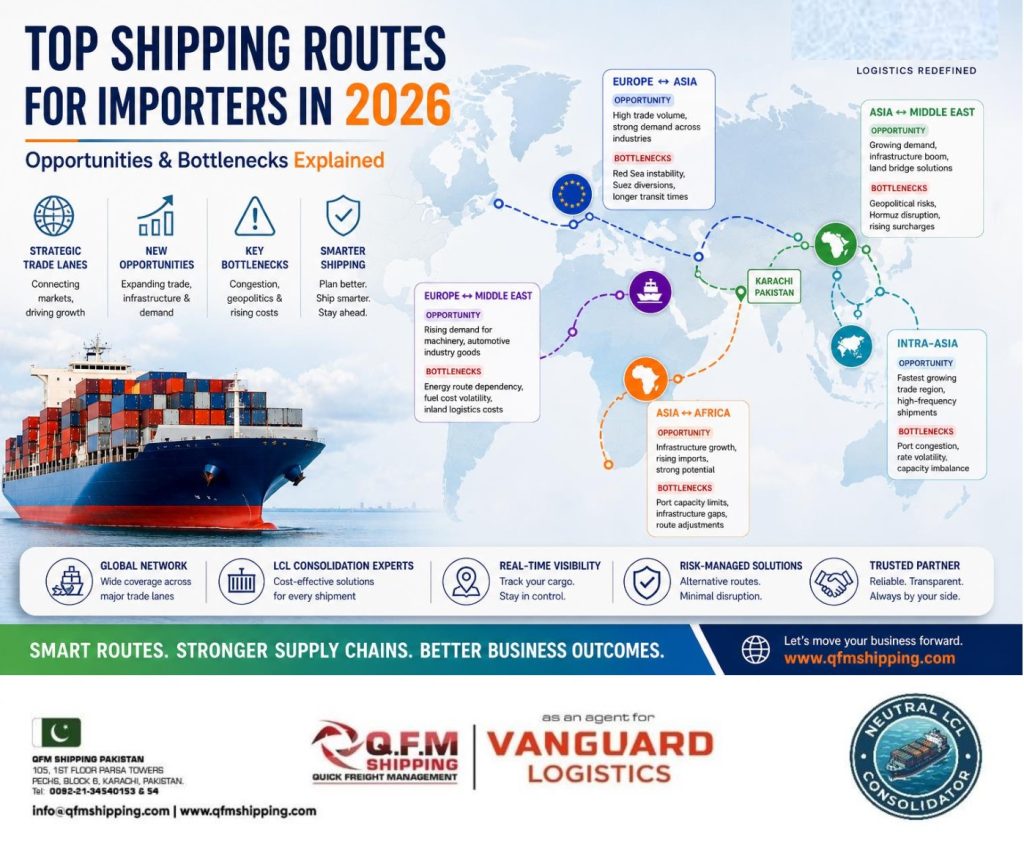
1. Asia → Middle East: High-Growth Trade Lane with Strategic Importance
Opportunities
- Rapid infrastructure and retail expansion across Gulf economies
- Strong demand for consumer goods, electronics, and construction materials
- Increasing use of multi-modal solutions (sea + land corridors)
Bottlenecks
- Strait of Hormuz geopolitical sensitivity
- Rising insurance and fuel surcharges
- Capacity shifts due to regional instability
QFM Advantage
QFM Shipping enables:
- Flexible routing via Fujairah, Jebel Ali, and regional hubs
- Cost-efficient LCL consolidation services
- Faster cargo movement through optimized trade lanes
2. Asia → Europe: The Most Critical (Yet Disrupted) Global Route
Opportunities
- One of the highest-volume global trade corridors
- Strong demand from e-commerce and manufacturing sectors
- Continuous reliance on Asian exports
Bottlenecks
- Red Sea disruptions impacting Suez Canal routes
- Transit delays due to rerouting via Cape of Good Hope
- Increased freight costs and longer transit times
Strategic Insight
Importers are now:
- Balancing cost vs speed
- Using consolidation to reduce per-unit shipping costs
- Diversifying routes to mitigate risk
3. Europe → Middle East: Stable Demand with Growing Trade Links
Opportunities
- Strong demand for machinery, automotive, and industrial goods
- Expansion of logistics hubs in UAE and Saudi Arabia
- Growth in re-export markets
Bottlenecks
- Dependence on energy trade routes
- Inland logistics cost fluctuations
QFM Strength
- Strong regional partner network
- Multi-port delivery strategies
- End-to-end customs handling
4. Intra-Asia Routes: The Fastest Growing Trade Network
Opportunities
- High-frequency shipments across short distances
- Growing manufacturing and distribution hubs
- Increasing demand for flexible logistics
Bottlenecks
- Port congestion in major Asian hubs
- Rate volatility due to demand spikes
QFM Edge
- Efficient consolidation hubs
- Frequent sailing schedules
- Reduced transit costs through optimized routing
5. Asia → Africa: Emerging Trade Corridor with Long-Term Potential
Opportunities
- Rising demand for infrastructure and industrial imports
- Expanding trade partnerships
- Improving port infrastructure
Bottlenecks
- Limited logistics infrastructure in some regions
- Capacity constraints and delays
Strategic Approach
- Flexible routing
- Risk-managed logistics planning
- Strong agent networks
Key Trends Shaping Shipping Routes in 2026
1. Geopolitical Risk is Redefining Trade Lanes
Routes are no longer fixed—dynamic rerouting is becoming standard.
2. Cost Volatility Across All Modes
Freight rates fluctuate due to demand, fuel, and disruptions.
3. Shift Toward LCL Consolidation
More importers are choosing Less-than-Container Load (LCL) for:
- Lower cost
- Higher flexibility
- Reduced inventory risk
4. Technology-Driven Visibility
Real-time tracking and predictive logistics are now essential.
How Importers Should Choose the Right Shipping Route
To optimize logistics performance, importers must evaluate:
✔ Transit Time vs Cost
✔ Route Stability & Risk Exposure
✔ Availability of Alternative Routes
✔ Freight Forwarder Expertise
Why QFM Shipping is the Preferred Logistics Partner
QFM Shipping delivers:
- Global trade lane expertise
- Specialized LCL consolidation services
- Real-time shipment visibility
- Alternative routing strategies
- Reliable global partner network
Conclusion: Winning in 2026 Requires Smarter Route Strategy
There is no single “best” shipping route anymore.
Success in 2026 depends on:
- Strategic planning
- Route flexibility
- Strong logistics partnerships
Importers who adapt quickly to changing trade lanes will:
✔ Reduce costs
✔ Avoid disruptions
✔ Gain competitive advantage
Ready to Optimize Your Shipping Routes?
Partner with QFM Shipping to unlock smarter, faster, and more reliable freight solutions across global trade lanes.
 Request a Free Consultation Optimize Your Supply Chain Strategy Start Shipping Smarter Today
QFM Shipping Pakistan
Karachi : Suite # 104 & 105, 1st Floor Parsa Towers PECHS Block 6 Karachi
Tel: 0092-21-34540153 & 54
Lahore: Suite # 1617, 16th Floor, Al Hafeez Executive Gulberg III, Lahore
Tel: 0092-42-35772611 & 12
Email: pricing.pkkhi@qfmshipping.com
Mobile: 0092-321-8280327
Tags:
Top Shipping Routes for Importers in 2026, global shipping routes 2026, QFMShipping, freight forwarding trade lanes, Asia Europe shipping routes, Asia Middle East logistics, LCL consolidation routes, shipping bottlenecks 2026, import logistics strategy, global freight trends 2026
