
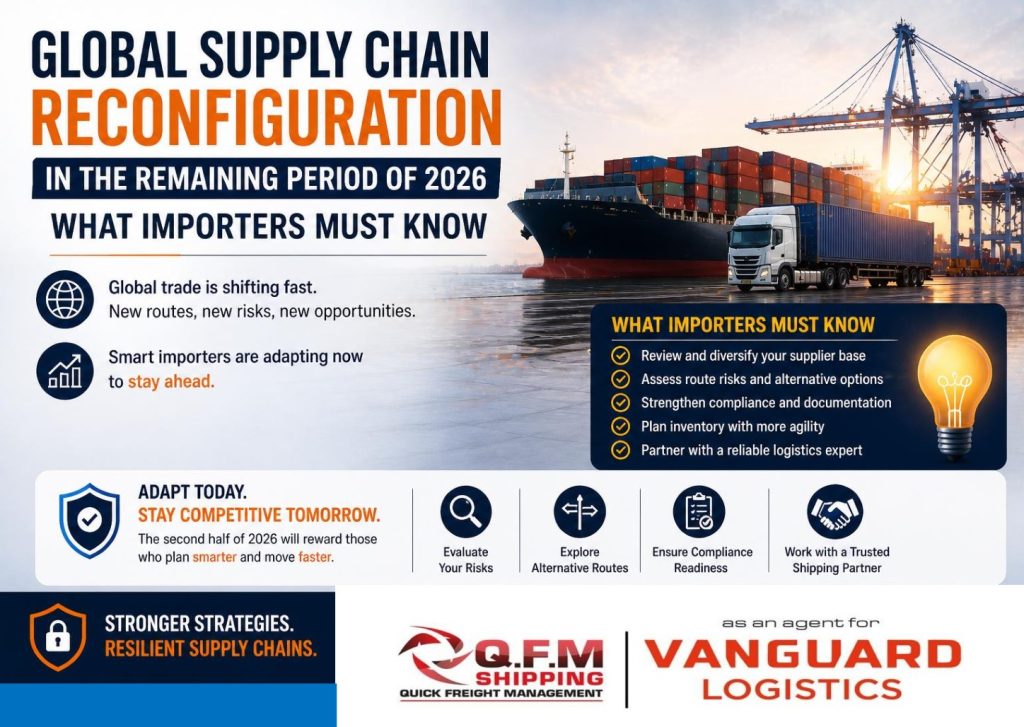
Global Supply Chain Reconfiguration in 2026: What Importers Must Know
The global supply chain is no longer what it was just a few years ago.
In 2026, businesses are facing a fundamental reconfiguration of how goods move across the world—driven by geopolitical shifts, cost pressures, and the need for resilience.
For importers, this isn’t just a trend.
👉 It’s a strategic turning point.
What Is Supply Chain Reconfiguration?
Supply chain reconfiguration refers to the restructuring of sourcing, production, and logistics networks to improve:
- Efficiency
- Cost control
- Risk resilience
- Speed to market
It involves moving away from single-source, long-distance supply chains toward more flexible and diversified models.
⚡ Key Drivers of Supply Chain Changes in 2026
1. Regionalization Over Globalization
Businesses are shifting toward:
- Nearshoring and regional sourcing
- Reduced dependency on single countries
Impact: Shorter lead times and reduced disruption risk
2. Rising Freight Cost Volatility
Shipping costs remain unpredictable due to:
- Fuel fluctuations
- Port congestion
- Demand-supply imbalance
👉 Importers must plan smarter—not just cheaper
3. Increased Risk & Disruption
Global trade faces:
- Political uncertainties
- Regulatory changes
- Climate-related disruptions
Result: Supply chains must be risk-resistant
4. Digital Transformation in Logistics
Technology is reshaping logistics through:
- Real-time tracking
- Data-driven decision-making
- Automation
👉 Visibility is becoming a competitive advantage
5. Shift Toward Flexible Shipping Models
Rigid shipping strategies are being replaced by:
- LCL (Less than Container Load)
- Multi-modal logistics
- Dynamic routing
Flexibility is now critical for growth
What This Means for Importers
Importers who fail to adapt will face:
- Higher costs
- Delays
- Reduced competitiveness
Those who adapt will gain:
- Faster delivery cycles
- Better cost control
- Stronger supply chain resilience
Smart Strategies for Importers in 2026
1. Diversify Your Supplier Base
Avoid reliance on a single source.
👉 Multi-sourcing reduces disruption risk and improves flexibility
2. Use LCL for Agility
LCL shipping allows:
- Smaller, more frequent shipments
- Reduced inventory pressure
- Faster response to demand
👉 Related: LCL Shipping Guide (Internal Link)
3. Optimize Cost Through Planning
Instead of reacting to rates:
- Forecast shipping costs
- Plan shipments strategically
- Use consolidation effectively
4. Strengthen Compliance & Documentation
With changing regulations:
- Ensure accurate documentation
- Stay updated on trade rules
👉 Prevent delays and penalties
5. Partner With Strategic Logistics Experts
Working with experienced providers like QFM Shipping ensures:
- Smarter routing decisions
- Cost-efficient shipping
- Risk-managed logistics
- End-to-end supply chain visibility
Real-World Example
Scenario:
An importer dependent on a single overseas supplier.
Challenge:
- Delays due to regional disruption
- Increased shipping costs
Solution:
- Shift to multiple suppliers
- Use LCL shipping for flexibility
Outcome:
- Faster shipments
- Reduced risk
- Improved cost control
Common Mistakes to Avoid
- ❌ Relying on one supplier
- ❌ Ignoring cost fluctuations
- ❌ Using rigid shipping strategies
- ❌ Overlooking compliance
- ❌ Lack of contingency planning
Why Choose QFM Shipping?
At QFM Shipping, we help businesses adapt to changing global logistics by offering:
✔ Flexible LCL and FCL solutions
✔ Strategic supply chain planning
✔ Cost optimization strategies
✔ Risk management support
✔ Global network expertise
👉 Our goal: Make your supply chain future-ready
Prepare Your Supply Chain for 2026
The future of logistics belongs to businesses that adapt early.
👉 Request a Free Consultation
👉 Optimize Your Supply Chain Strategy
👉 Start Shipping Smarter Today
QFM Shipping Pakistan
Karachi : Suite # 104 & 105, 1st Floor Parsa Towers PECHS Block 6 Karachi
Tel: 0092-21-34540153 & 54
Lahore: Suite # 1617, 16th Floor, Al Hafeez Executive Gulberg III, Lahore
Tel: 0092-42-35772611 & 12
Email: pricing.pkkhi@qfmshipping.com
Mobile: 0092-321-8280327
Conclusion
Global supply chains are evolving—and fast.
In 2026, success will depend on:
- Flexibility
- Strategy
- Smart logistics decisions
With the right approach—and the right partner like QFM Shipping—you can turn disruption into opportunity.
FAQ
Q1: What is supply chain reconfiguration?
It is the restructuring of sourcing and logistics networks to improve efficiency and resilience.
Q2: Why are supply chains changing in 2026?
Due to cost volatility, geopolitical risks, and the need for flexibility.
Q3: How can importers adapt to supply chain changes?
By diversifying suppliers, using flexible shipping methods, and optimizing logistics strategies.
Tags:
Global supply chain reconfiguration 2026, supply chain trends 2026, global logistics changes, import strategy 2026, supply chain disruption, freight trends, LCL shipping strategy, global trade shifts, logistics optimization.
