Pakistan’s Role in Post-War Trade Recovery Logistics
The recent ceasefire involving Iran has brought cautious optimism to global trade. However, the logistics landscape remains far from stable. Shipping routes are still adjusting, freight costs remain elevated, and uncertainty continues to shape decision-making across supply chains.
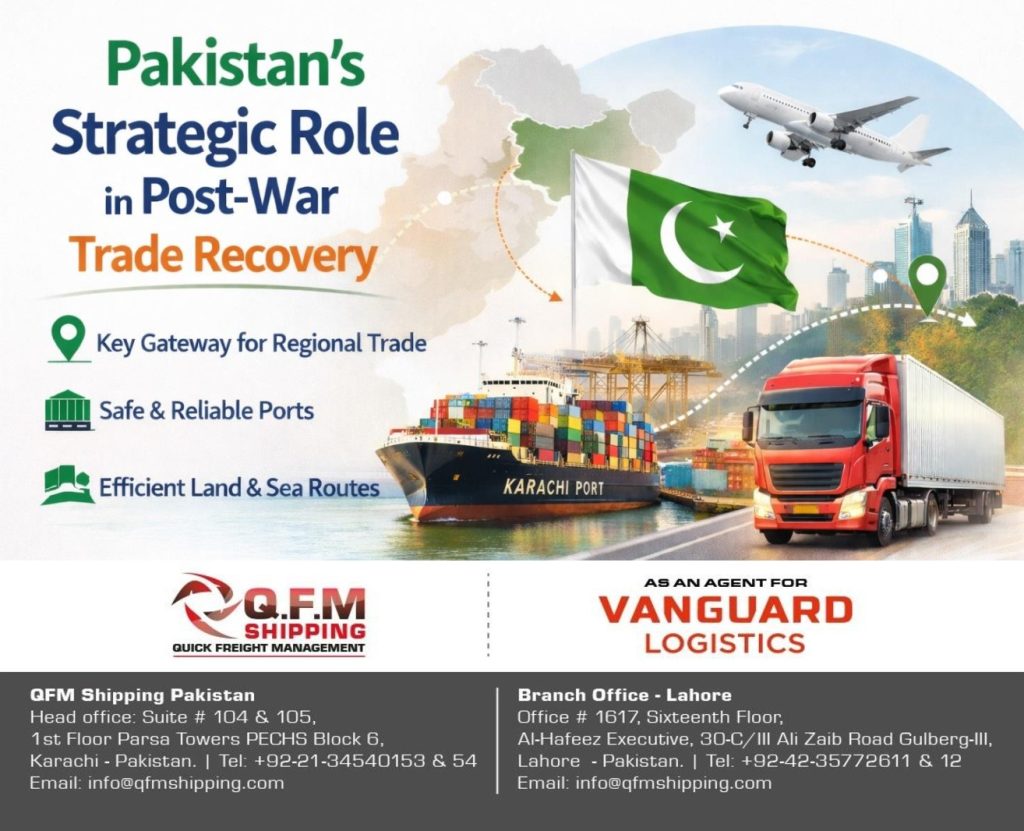
In this evolving environment, Pakistan trade recovery logistics is gaining significant attention. Positioned at the crossroads of South Asia, the Middle East, and Central Asia, Pakistan is emerging as a strategic logistics hub for post-war trade recovery.
For exporters, importers, and freight forwarders, this shift presents both opportunities and competitive advantages—especially when working with experienced partners like QFM Shipping.
Why Global Trade Has Not Fully Recovered Yet
Despite the ceasefire, several structural challenges persist:
- Backlog of delayed vessels across key shipping corridors
- War-risk insurance premiums still impacting costs
- Rerouted shipping lanes causing longer transit times
- Carrier hesitancy in fully resuming Gulf operations
This transitional phase is expected to last several weeks, making strategic routing decisions more critical than ever.
Pakistan’s Strategic Advantage in Trade Recovery
1. Prime Geographic Location
Pakistan sits at a highly strategic intersection connecting:
- Middle East (UAE, Saudi Arabia, Oman, Qatar)
- South Asia (India, Bangladesh, Sri Lanka)
- Central Asia (via land corridors)
This positioning allows Pakistan to function as a natural transit and consolidation hub, especially when traditional Gulf routes face disruption.
2. Karachi & Port Qasim: Reliable Gateways
Pakistan’s two major ports are playing a critical role:
- Karachi Port – Established, high-volume trade hub
- Port Qasim – Modern infrastructure with expanding capacity
These ports offer:
- Reduced congestion compared to regional alternatives
- Faster cargo handling during disruption periods
- Strategic access to GCC markets
👉 This makes Pakistan an increasingly preferred routing option for LCL and FCL shipments.
3. Rise of Alternative Trade Routes
With uncertainty in traditional shipping lanes, global logistics is shifting toward:
- Transshipment hubs
- Indirect routing strategies
- Flexible multimodal logistics solutions
Pakistan is becoming a key node in these alternative routes, particularly for cargo moving between Asia and the GCC.
The Growing Importance of LCL & Consolidation
In times of disruption, Less-than-Container Load (LCL) shipping becomes essential:
- Allows flexible shipment volumes
- Reduces cost risks during volatile freight markets
- Enables faster consolidation and movement
QFM Shipping specializes in neutral LCL consolidation, ensuring:
- Confidentiality for freight forwarders
- Reliable cargo handling
- Optimized routing even during uncertainty
How QFM Shipping Supports Post-War Trade Recovery
As the logistics industry navigates this transitional phase, QFM Shipping Pakistan is positioned as a trusted partner by offering:
✅ Strategic Routing Expertise
Helping clients avoid high-risk and congested routes
✅ Reliable LCL Consolidation
Ensuring efficient cargo movement with reduced delays
✅ Strong Regional Network
Connecting Pakistan to GCC and global markets seamlessly
✅ Risk-Aware Logistics Planning
Adapting quickly to geopolitical and market changes
Freight Trends to Watch in 2026
Businesses should prepare for:
- Continued rate volatility despite ceasefire
- Gradual normalization over 6–8 weeks
- Increased demand for secure and alternative routes
- Growth in transshipment-based logistics models
👉 Companies that adapt early will gain a competitive advantage in trade recovery.
Why Pakistan Will Lead the Next Phase of Global Trade
Pakistan’s emergence is not temporary—it reflects a broader shift in global logistics:
- Diversification away from high-risk zones
- Demand for resilient supply chains
- Increased reliance on regional logistics hubs
With strong infrastructure, strategic geography, and experienced logistics providers like QFM Shipping, Pakistan is set to become a long-term pillar of global trade recovery.
Conclusion
The ceasefire may have paused the conflict, but it has not yet stabilized global logistics. In this critical transition period, businesses must rethink their shipping strategies.
Pakistan trade recovery logistics is proving to be a powerful solution—offering reliability, flexibility, and strategic advantage.
By partnering with QFM Shipping, exporters and freight forwarders can navigate uncertainty with confidence and position themselves for success in the evolving global trade landscape.
Call to Action
Looking for a reliable logistics partner in uncertain times?
Connect with QFM Shipping today to optimize your cargo routes, reduce risks, and stay ahead in post-war trade recovery.
Partner with QFM Shipping to optimize your LCL shipments through Karachi and Port Qasim.
Contact us today to streamline your global logistics operations.
QFM Shipping Pakistan
Karachi : Suite # 104 & 105, 1st Floor Parsa Towers PECHS Block 6 Karachi
Tel: 0092-21-34540153 & 54
Lahore: Suite # 1617, 16th Floor, Al Hafeez Executive Gulberg III, Lahore
Tel: 0092-42-35772611 & 12
Email: pricing.pkkhi@qfmshipping.com
Mobile: 0092-321-8280327
Tags:
Pakistan logistics hub, post-war trade recovery, GCC shipping routes, LCL Pakistan, Karachi Port logistics, Port Qasim shipping, freight recovery trends, Middle East shipping disruption, alternative trade routes, QFM Shipping Pakistan
Read More:
1- Reliable Logistics Partner | Pakistan LCL Shipping
2- Neutral LCL Consolidation | Protect Your Business
3- The Hidden Logistics Strategy Top Freight Forwarders Use
